


BaldeneySteig
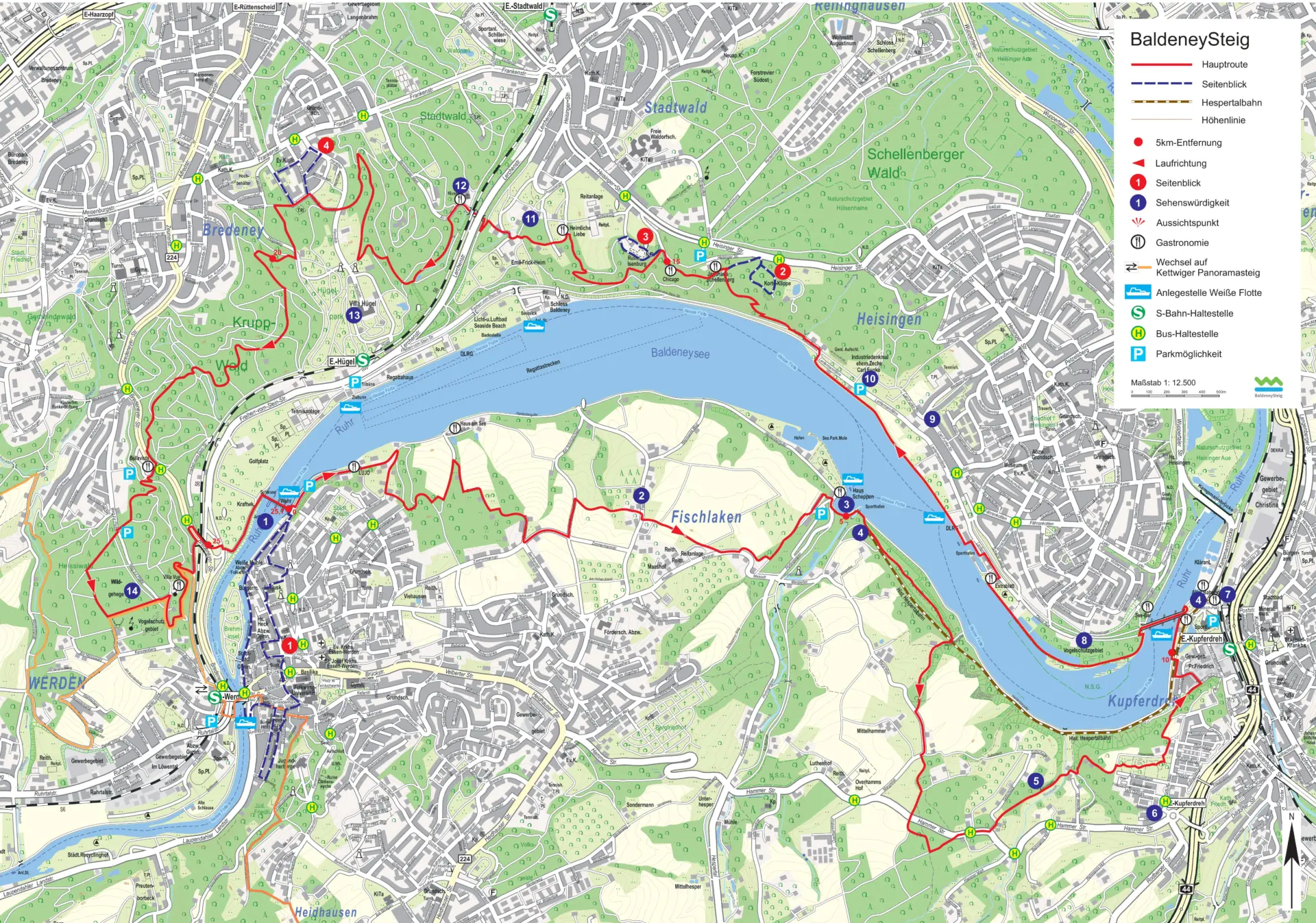
There’s no doubt about it: hiking has long been about more than just a miller’s pastime. That’s a good thing, too, because since 2017 the BaldeneySteig, almost 26 kilometres long, has invited hikers to explore the area around Essen’s reservoir. The route leads through forests, across meadows and fields, and past rustic farmsteads. Wonderful views are included. There are also four detours to special cultural highlights, which can be reached on foot from the main route. When your feet need a break, you can also cover sections of the trail, which has 600 metres of elevation gain, by public transport, the Weiße Flotte or the Hespertalbahn.
The route to take with you
Route
Route information
1. Weir
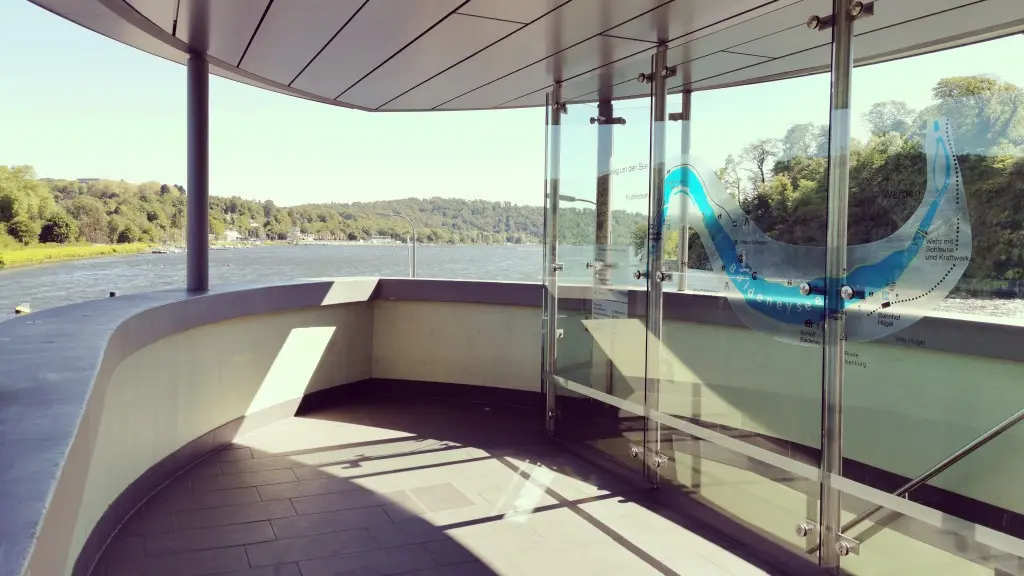
The weir in Essen-Werden created the Baldeneysee in 1933. Two turbines generate electricity here. At the same time, the weir serves as a crossing from one side of the lake to the other.
2. Alt-Fischlaken Farming Community
Only a few full-time farmers remain in Essen, some of them in Alt-Fischlaken. There, you can still see a group of old farmsteads.
3. Haus Scheppen
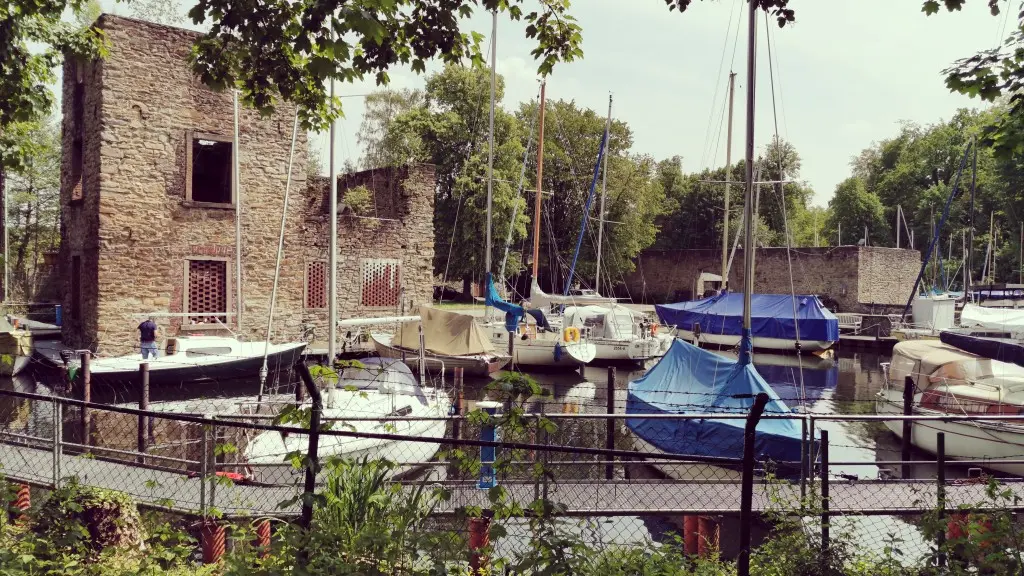
This aristocratic fief dating from the 14th century became a moated castle when the Ruhr was dammed and was badly damaged during the Second World War. Today, the ruins directly on the Baldeneysee are a popular meeting place for motorcyclists and walkers.
4. Hespertal Railway Museum Railway Essen
The museum railway connects Kupferdreh station with the former Pörtingsiepen colliery. The 3.5 km route runs close to the Baldeneysee and offers beautiful views.
5. Site of the Former Kaiserin Augusta Colliery
The hills along the Ruhr were once dotted with small collieries, traces of which are now often visible only to experts. For example, remains of retaining walls can still be seen on Augustaweg.
6. Neolithic Stone Cist Grave
The burial site is considered the oldest surviving structure in the city of Essen and dates from between 3500 and 2200 BC. The grave was discovered in 1937 during the construction of a barracks.
7. Old Kupferdreh Station
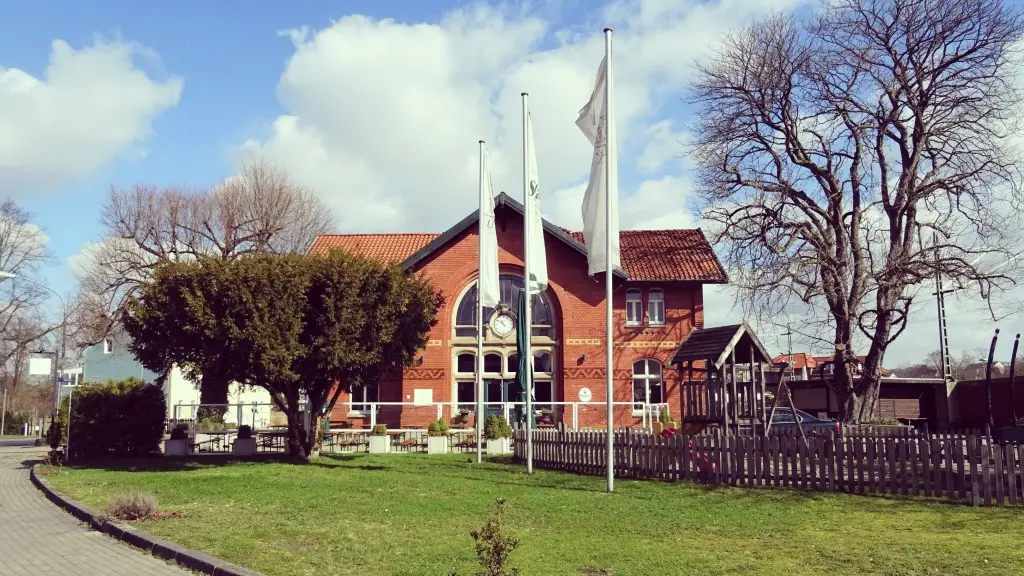
This impressive suburban railway station was built in 1898 and no longer serves a transport function today. The brick building is worth seeing both outside and inside, especially the waiting room with its stucco decoration.
8. “Heisinger Bogen” Bird Sanctuary
The bird sanctuary was established when the Baldeneysee was created. The area, with remnants of alluvial forest, is home to rare bird species and is of great importance as a resting place for migratory birds.
9. Carl Funke Estate
Among the colliery settlements in southern Essen, the Carl Funke estate, built from 1900 onwards, stands out for its architectural unity and its location above the Ruhr Valley.
10. Industrial Heritage Site of the Former Carl Funke Colliery
The Carl Funke I headframe is one of the few structural remnants of the colliery, which operated until 1973. It is the most striking monument to industrial history in Essen’s Ruhr Valley.
11. Baldeney Forest Village
The half-timbered houses, loosely scattered across the Baldeney district, once belonged to the Vittinghoff-Schell family and are now privately owned.
12. St. Aegidius Klusen Chapel and Kluse
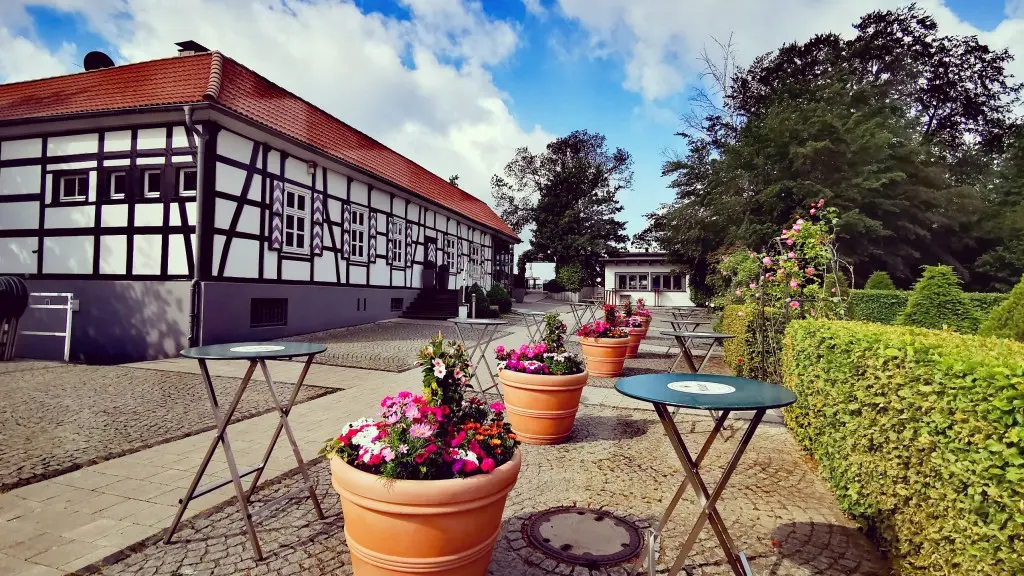
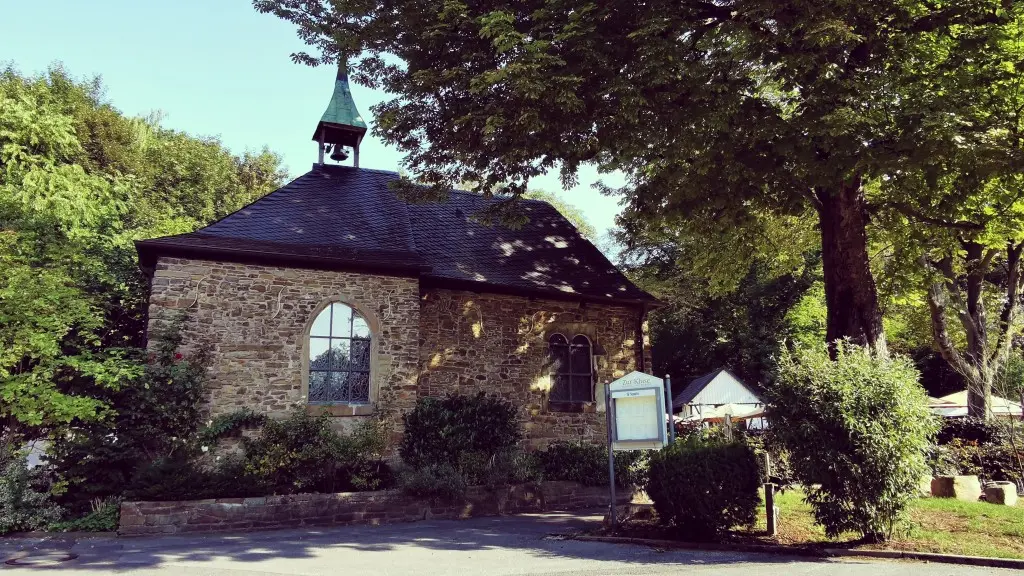
The chapel was built before 1300. A half-timbered house was added much later and today houses a restaurant.
13. Villa Hügel and Hügel Park
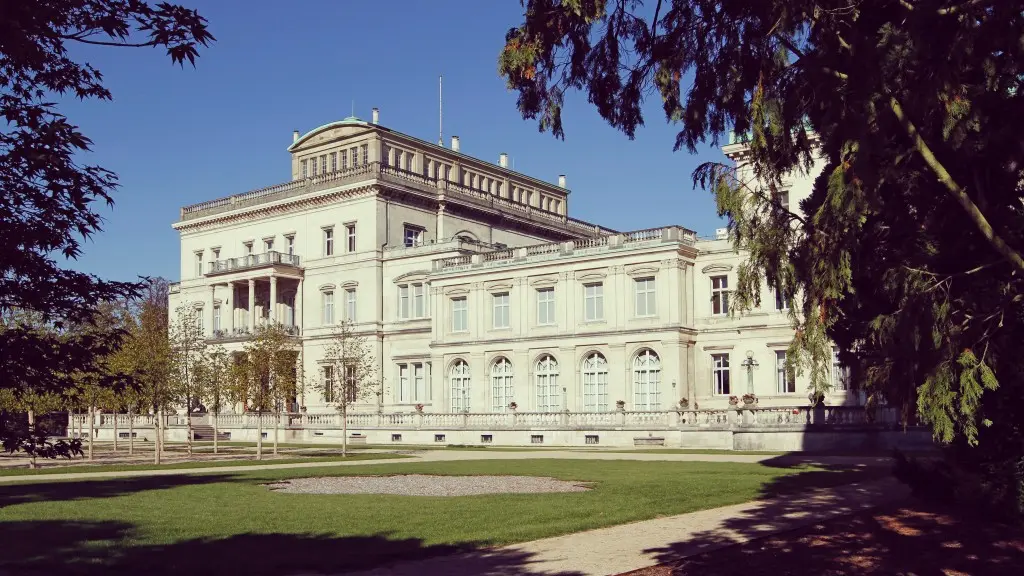
Villa Hügel is the former residence of the Krupp family and is surrounded by a large park. Both are owned by the Alfried Krupp von Bohlen und Halbach Foundation and are open to visitors.
14. Essen Wildlife Enclosure
Maintained by a support association, red deer and wild boar roam freely within the fenced six-hectare wildlife enclosure in Heissiwald.
- Al Casale Bellavista
- Bredeneyer Str. 183, 45133 Essen
www.al-casale-bellavista.de - Café Extrablatt
- Lanfermannfähre 118, 45259 Essen
www.cafe-extrablatt.de - Haus am See
- Harnscheidts Höfe 1, 45239 Essen
www.instagram.com - Haus Scheppen
- Hardenbergufer 389, 45239 Essen
- Jagdhaus Schellenberg
- Heisinger Straße 170a, 45134 Essen
www.jagdhaus-schellenberg.de - LUJO Seecafé & Restaurant
- Hardenbergufer 121, 45239 Essen
www.lujo.de - LUKAS
- Prinz-Friedrich-Platz 1, 45257 Essen
www.lukas-essen.de - See-Bar
- Stauseebogen 37-39, 45259 Essen
www.see-bar.com - Steakhouse Restaurant Chicago
- Schwarze-Lenen-Weg 38, 45134 Essen
www.chicago-essen.de - Villa Vue
- Weg zur Platte 73, 45239 Essen
www.villavue.de - Wirtshaus zur heimliche Liebe
- Baldeney 33, 45134 Essen
www.heimliche-liebe.de - Zur Kluse
- An der Kluse 27b, 45133 Essen
www.zurkluse.de
1. Werden Side Trip
From the BaldeneySteig, this side trip to Werden leads directly to a roughly one-hour walk through one of Essen’s most historically significant districts. Werden has a picturesque old town and important architectural monuments, marked with QR codes that provide access to images, text and audio.
The route through Werden first passes the former Feulgen cloth factory, whose halls stood close to the banks of the Ruhr and now serve as residences. They are an early example of industrial monuments being converted into residential lofts. Passing a historic lock and Neukircher Mill, the route follows Heyerstrang and Brehminsel to Treidelplatz, where the Werden-Land Historic Trail also begins. After passing beneath the Gustav-Heinemann Bridge, cross Laupendahler Landstraße.
From there, continue to Wesselswerth, with its notable Neoclassical buildings. Next is Dingerkus Garden House, built in 1790 by Johann Everhard Dingerkus, the last chancellery director of Werden Abbey. An association now looks after this late-Baroque gem and its enchanting garden. The route approaches the former Werden Abbey through the Weberviertel. In the High Middle Ages, the monastery was one of the most important in Christendom. Highlights include the so-called prison wing, the new library and the Baroque buildings that have housed the Folkwang University of the Arts since 1946. This institution also contributes to Werden’s distinctive atmosphere. The old Werden Market marks the beginning of Werden’s historic old town, dominated by the former Abbey Church of St. Ludgerus, which is well worth a visit. The crypt contains the tomb of Saint Ludgerus, who founded the abbey and church around the year 800, thereby initiating the settlement of Werden. Today, St. Ludgerus Parish Church has the status of a basilica. The route continues through the old town’s alleyways, with their beautifully restored half-timbered houses and buildings from the Wilhelminian era.
Passing the splendidly situated Protestant Church of Werden, whose tall tower was a deliberate response to the abbey church, the route leads to St. Lucius Church, considered the oldest parish church north of the Alps. The nearby Bürgermeisterhaus, dating from 1895, now serves as a cultural centre. The side trip then approaches its starting point again via the so-called Rondellviertel, with its monuments to Wilhelm I, Bismarck and Moltke, as well as Kaiser Friedrich III.
Length: 4 km
Further information: www.essener-ruhrperlen.de/werden
2. Korte Klippe Side Trip
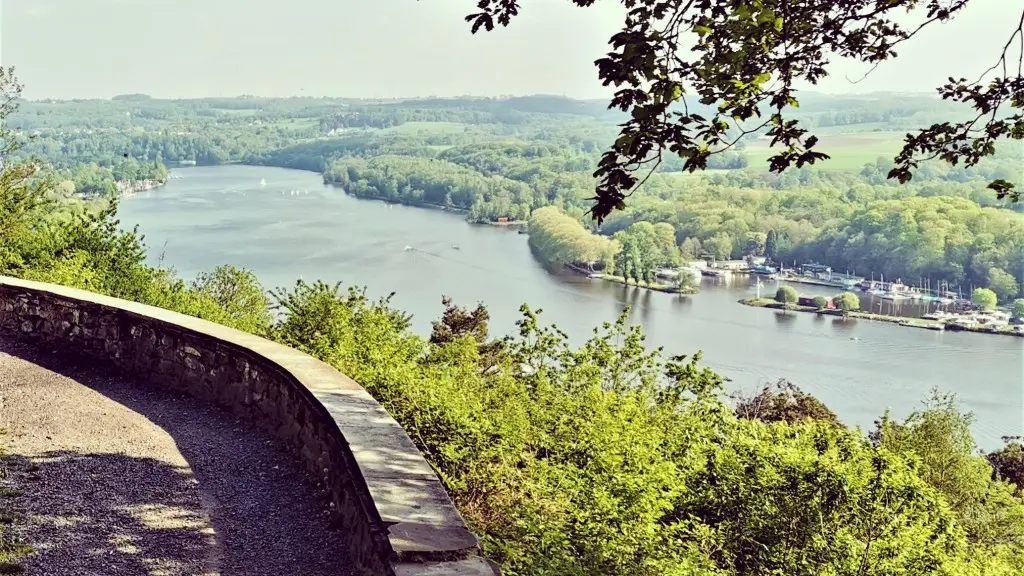
Of the many viewpoints on Lake Baldeney and along the trail, many consider Korte Klippe the most beautiful. It is close to Jagdhaus Schellenberg and is named after Rudolf Korte, a former director of horticulture for Essen, who made a name for himself, among other things, as head of the Botanical Garden, the predecessor of Grugapark. From Korte Klippe, one of the 31 “Essener Aussichten” viewpoints, you can see the full extent of Lake Baldeney.
Length: 700 m
3. Neu-Isenburg Castle Ruins Side Trip
Around 1240, Count Dietrich von Altena-Isenberg built a castle in a strategically advantageous position high above the Ruhr. To distinguish it from the older Hattingen Isenburg, it became known to history as Neu-Isenburg. The proud fortress was short-lived: just 48 years after its construction, Neu-Isenburg was destroyed during a feud. During an excavation that began in 1927, the Ruhr Museum—then still known as the Ruhrlandmuseum—unearthed the remains of the ruins that can still be seen today.
Length: 550 m
4. Brandenbusch Settlement Side Trip
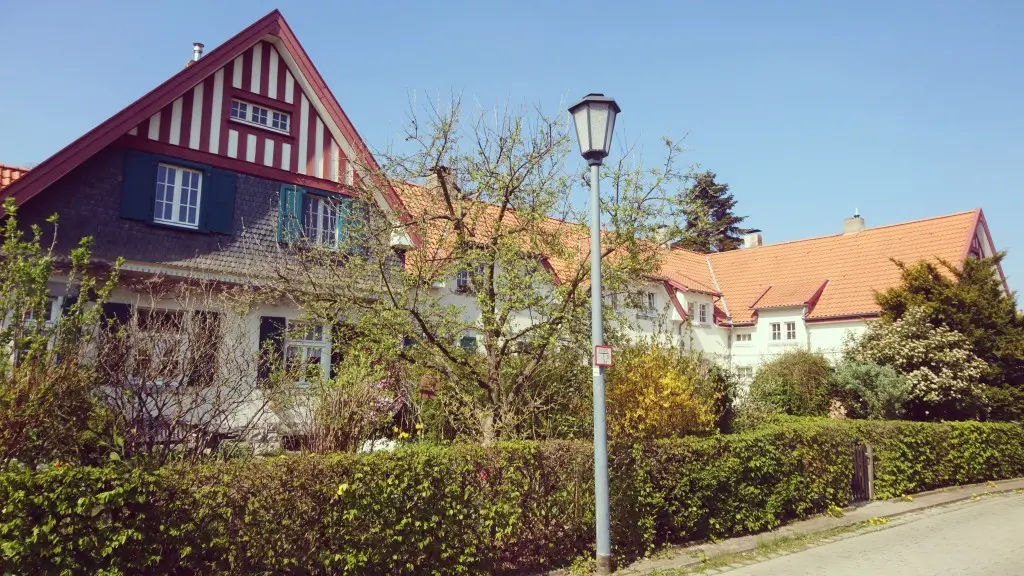
Brandenbusch holds a special place among the many Krupp settlements. Set in a beautiful location above Hügel Park, Villa Hügel staff lived here close to their workplace, serving as butlers or gardeners, cooks or washerwomen. The settlement was built in a cottage style very typical of Krupp. Its defining features are exposed half-timbering and the picturesque overall appearance of a small garden city.
Length: 800 m
Image gallery
Getting around on the trail
- By public transport from Essen Central Station
- S-BAHN
S6 Essen Hbf – Werden S-Bf
S9 Essen Hbf – Kupferdreh S-Bf
TRAM LINES
Line 107/108 Essen Hbf – Bredeney (connection to Line 169 towards Werden S-Bf)
EXPRESS BUS LINES
SB19 Essen Hbf – Werdener Markt
BUS LINES
145 Essen Hbf – Heisingen Baldeneysee
155 Essen Hbf – Kupferdreh S-Bf
For more information, visit: www.ruhrbahn.de - Weiße Flotte Baldeney
- Timetable at www.baldeneysee.com
Fancy a trip to Essen?
Contact
EMG - Essen Marketing GmbH
Tourist-Information Essen
Kettwiger Str. 35
45127 Essen